

AMP2 overview
AMP2 provides Blockstream protocol for issuing and managing digital assets on the Liquid Network. The page explains AMP2 scope, properties, users, and asset lifecycle.
AMP2 (Asset Management Protocol v2) is Blockstream's protocol for issuing and managing digital assets on the Liquid Network.
AMP2 is designed for regulated and high assurance token operations where issuers need programmatic control over asset lifecycle, transfer permissions, and operational security, without running their own Liquid node infrastructure.
The problem AMP2 solves
Issuing assets on Liquid is straightforward. Managing them at scale is not. Issuers who operate tokenized securities, stablecoins, or internal instruments face a set of recurring challenges:
- Transfer control: restricting who can hold and move an asset requires policy enforcement at the transaction level, not just at the application layer.
- Multi party signing: no single party should be able to unilaterally move assets. A two signature model (issuer + server) provides mutual accountability.
- Infrastructure burden: running an Elements node, managing UTXOs, and broadcasting transactions adds operational complexity that most issuers want to avoid.
- Auditability: every issuance, transfer, burn, and lock must be traceable for compliance and internal controls.
- Security: bearer-token-only APIs are insufficient for financial asset management. Request authenticity and response confidentiality need cryptographic guarantees beyond TLS.
AMP2 addresses all of these through a single API surface backed by HSM protected signing and COSE encrypted communication.
Where AMP2 sits in the stack
AMP2 operates as an asset management protocol on top of the Liquid Network. The Liquid Federation, a group of network operators, enforces network permissions and transaction policy. Functionaries propose, sign blocks, and order transactions. AMP2 sits in the asset management layer, enforcing issuer defined transfer and investor policies on Liquid assets alongside other potential asset management providers.
The network supports all kinds of financial assets and instruments: USD deposits, promissory notes, letters of credit, securities, derivatives, and more. End users custody assets themselves and transact peer to peer, with or without trusted custodian intermediaries.
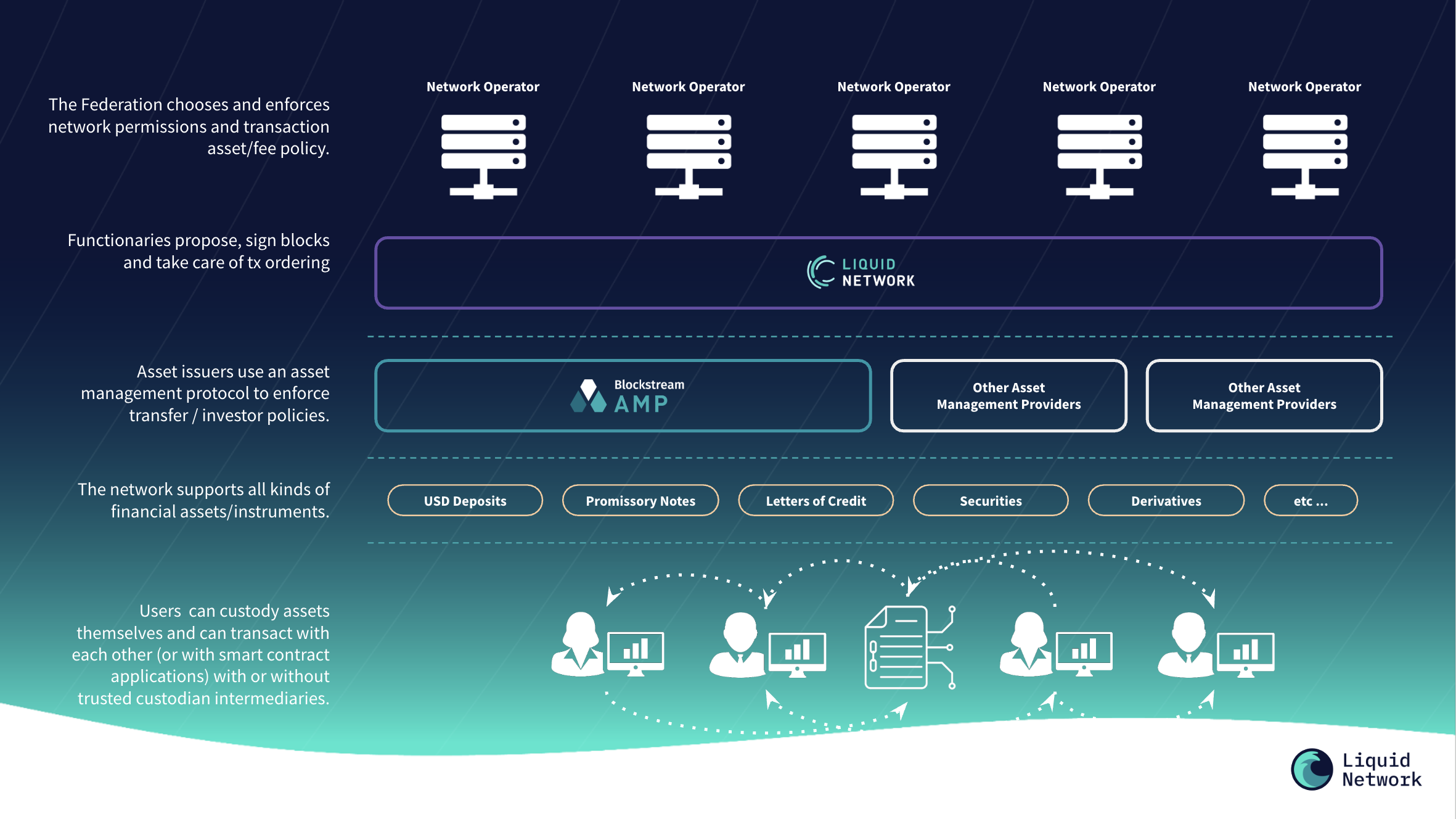
Issuers connect through the private JS SDK, which handles COSE message wrapping. AMP2 handles all transaction construction and chain broadcast internally. Investors and venues connect through LWK (Liquid Wallet Kit) and a Proxy Service that translates their requests into COSE protected AMP2 calls. They build transactions locally using LWK, and the proxy forwards them to AMP2 for policy enforcement and HSM backed cosigning.
Why AMP2
| Property | What it means |
|---|---|
| Compliance friendly | Per wallet transfer restrictions enforced at signing time by the HSM |
| Privacy by default | Liquid Confidential Transactions hide amounts and asset types on chain |
| Fast settlement | Liquid's ~1 minute block time vs. Bitcoin's ~10 minutes |
| Full lifecycle | Issue, send, reissue, burn, lock/unlock through a single PSET based flow |
| Integration first | Typed SDK for issuers, LWK + Proxy for investors and venues |
| Bitcoin ecosystem | Built on Liquid, anchored to Bitcoin through federated two way peg |
Who uses AMP2
- Issuers: create assets, register wallets (their own and their investors'), set transfer restrictions, and execute lifecycle operations (send, reissue, burn, lock). Issuers use the private
@blockstream/crypticSDK alongside@blockstream/amp-registryand@blockstream/ecs-registry. - Investors and venues: receive and trade AMP2 managed assets through Liquid wallets. They interact via LWK and a Proxy Service that abstracts AMP2's COSE layer.
Asset lifecycle at a glance
- Blockstream will send you an invite to create your issuer account: provides credentials and public keys for COSE.
- Issuer generates key pairs: RSA for encryption, ECDSA for signing.
- Issuer activates account: uses invite data to authorize a device via the SDK.
- Issuer registers wallets: submits Liquid wallet descriptors; receives wallet IDs (WIDs).
- Issuer issues an asset: specifies supply, contract metadata, and reissuance tokens; receives PSET.
- Issuer signs and broadcasts: signs PSET locally, AMP2 cosigns via HSM, transaction is broadcast.
- Issuer manages lifecycle: sends assets to investor wallets, sets restrictions, reissues or burns supply.
- Issuer monitors state: checks balances, transaction history, UTXO state, and restriction policies.
What AMP2 does not do
AMP2 is not an investor CRM. It does not store investor names, KYC records, or category memberships. The protocol operates on wallets and assets. Any investor metadata belongs in the issuer's own systems.
Next steps
- Architecture: how the components fit together
- What is Liquid: the underlying network
- Issuer Quickstart: from invite to first asset
- Venue Quickstart: LWK setup and wallet registration
AMP Workflows
AMP and AMP2 documentation for Liquid asset issuance, wallet integration, tokenization, and operational playbooks.
Liquid overview
Liquid is a Bitcoin sidechain operated by a federation of functionaries. The page explains settlement, Confidential Transactions, asset issuance, and AMP2 relevance.